A field trip is not a departure
· 11 min read
Why booking engines built for ferries and tours cannot model a ship that calls at eight islands, and what the data model has to look like instead.
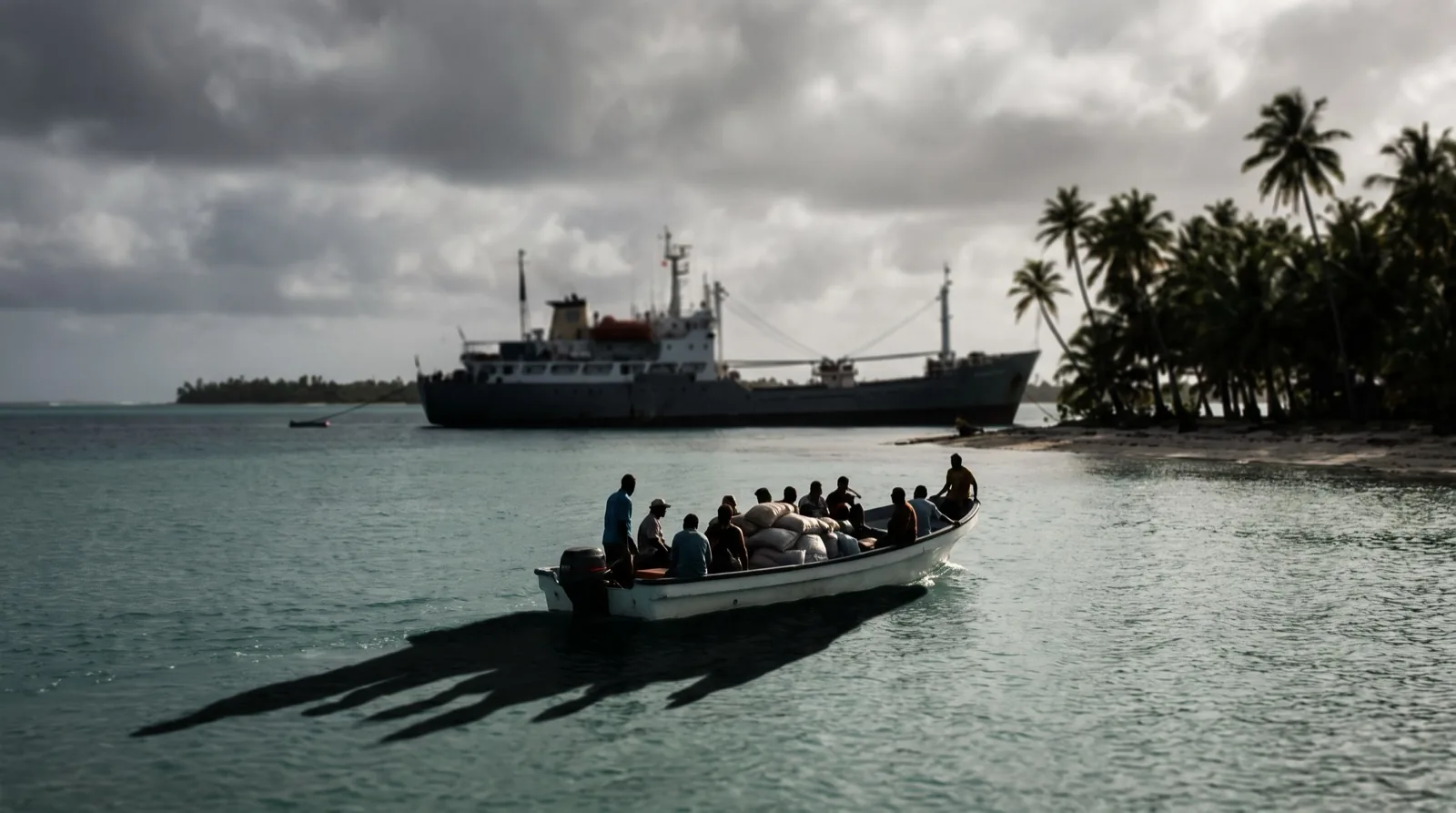
Every booking platform we looked at before writing Supaferry, from the enterprise ferry suites used by the large Nordic and Mediterranean lines to the tour marketplaces that sell whale-watching trips, sells the same thing: a departure. One origin, one destination, one time, one pool of seats. A departure is what a crossing is, and crossings are what most of the world's ferries do. A field trip is something else, and the difference is not cosmetic. It changes how seats are counted, how fares are computed, what a manifest is, and what the ship's master is legally responsible for at each stop.
This article explains what a field trip is, why the departure model fails on it, and how Supaferry stores a voyage so that the three things an island service cares about, seats, fares and the manifest, come out right without anyone keeping a parallel ledger on paper.
What a field trip actually is
The term comes from the Pacific. In the Federated States of Micronesia the national government runs two ships, the Caroline Voyager and the Micronesian Navigator, and the states run a few more. Their job is to connect the four state centres, Pohnpei, Chuuk, Yap and Kosrae, with dozens of outer islands and atolls that have no airstrip and, in many cases, no reef passage deep enough for the ship to enter the lagoon. A field trip is one voyage that leaves a state centre, calls at a chain of islands, and comes back. The Pohnpei Southern Run, to take a real schedule, leaves Dekehtik wharf, calls at Sapwuahfik, Nukuoro and Kapingamarangi, and returns by the same islands in reverse. Eight days, seven calls, two of them at the same island going out and coming back.
At most of those calls the ship does not dock. It anchors off the reef and the island's boats, or the ship's own tender, carry people and cargo across the lagoon. Passengers get on and off at every call. A family from Nukuoro rides to Kapingamarangi to visit relatives; a nurse boards at Pohnpei and leaves at Sapwuahfik; a student who finished the school year boards at Kapingamarangi and rides the whole return leg home. The ship's complement changes at each anchorage, and the number on board between any two islands is different from the number between any other two.
Nothing about this is unique to Micronesia. The Marshall Islands, Kiribati, Tuvalu, the Cook Islands, French Polynesia's Tuamotus, Vanuatu's northern islands and the outer Hebrides are served the same way, with a multi-stop voyage and a ship that is the only link for weeks at a time. The same pattern appears, in a milder form, on any ferry line that strings several islands into one sailing: the Aeolian hydrofoil that calls at Vulcano, Lipari, Salina, Panarea and Stromboli, or the Cyclades ferry that leaves Piraeus and calls at Syros, Mykonos, Naxos and Santorini. The field trip is the extreme case, and a system that handles it handles the milder cases for free.
Where the departure model breaks
A departure-based system has one inventory per sailing: three hundred seats on the 17:00 to Kapingamarangi. That works if everyone boards at the origin and leaves at the destination. On a field trip it fails three ways.
- Seats. If the system counts the Pohnpei to Nukuoro passengers against the same pool as the Nukuoro to Kapingamarangi passengers, it will refuse bookings that would fit, because the first group has left the ship before the second group boards. Or, if the operator tries to work around it by creating one product per island pair, it will sell the same physical seat twice on an overlapping stretch, because nothing links the Pohnpei to Kapingamarangi product to the Sapwuahfik to Nukuoro product even though both occupy the seat between Sapwuahfik and Nukuoro. Overselling on a government ship is not a customer-service problem. The certificate of inspection sets a maximum number of persons on board, and the master who sails above it is personally liable.
- Fares. The FSM tariff prices passage per mile, point to point, so the fare from Pohnpei to Nukuoro is different from the fare from Sapwuahfik to Nukuoro, and the fare for the whole loop is different again. A departure-based system has one price per product. To cover a seven-call voyage you would need twenty-one products, one per ordered pair, each with its own price, its own seat pool and its own name, and the agent at the counter would have to find the right one. Nobody does that; they sell a generic ticket and write the destination by hand.
- The manifest. The legally meaningful document is not the list of everyone who bought a ticket for the voyage. It is the list of who is on board between two specific islands, because that is what a search-and-rescue coordinator asks for when the ship is overdue, and what the state's marine safety administrator asks for after an incident. A departure-based system produces an attendee list for the sailing. It cannot say who was on board between Nukuoro and Kapingamarangi on the way back, because it does not know where anyone got off.
Overselling on a government ship is not a customer-service problem. The master who sails above the certificate is personally liable.
The model: voyages as ordered calls, bookings as legs
Supaferry stores a voyage as an ordered list of port calls. Each call has a port, a sequence number, an estimated arrival and an estimated departure. The first call has no arrival, the last has no departure. A voyage also carries a vessel, a code the operator uses on its own schedule documents (CV 05-26 is the Caroline Voyager's fifth voyage of the year) and a status that moves from scheduled to boarding, departed, completed or cancelled.
A booking does not reference a departure. It references a voyage, an origin call and a destination call, by sequence number. From those two numbers the system derives everything else: the set of legs the booking occupies (every leg from the origin's sequence up to, but not including, the destination's sequence), the miles sailed along those legs, the departure time at the origin, the estimated arrival at the destination, and the list of intermediate islands the passenger will see from the deck.
The out-and-back case, where the ship calls at the same island twice, is handled by resolving the booking's port pair to the first origin call that is followed by a destination call. A booking from Nukuoro to Pohnpei on the Southern Run resolves to the second Nukuoro call, sequence four, and the final Pohnpei call, sequence six, because the first Nukuoro call at sequence two is followed by Kapingamarangi, not by Pohnpei. The operator never has to think about this; the search simply shows one result for Nukuoro to Pohnpei with the right dates.
Seats: the tightest leg decides
Availability for a stretch is computed per leg and then reduced to the minimum. For each leg between two consecutive calls, the system sums the seats held by every booking whose own leg range covers that leg, in the requested class, and subtracts the sum from the vessel's capacity in that class. The number of seats available for Pohnpei to Kapingamarangi is the minimum across the three legs the stretch occupies. If Sapwuahfik to Nukuoro is the busiest leg, with ten seats left, then only ten seats can be sold from Pohnpei to Kapingamarangi, even if the other two legs are nearly empty. This is exactly what a master would say if asked by hand.
Two details follow from the law and the practice. Infants do not take a seat, because they travel on a lap and the certificate counts persons differently; the manifest still lists them. Unpaid holds count as taken seats until they expire, because an agency that has reserved ten places for a school group has reserved them, and the system must not sell them twice while the group walks to the Finance Office with the cash. When the hold expires, the seats return to inventory and the audit log records why.
- Capacity is defined per vessel and per class: deck and cabin berths on the FSM ships, since that is how the tariff is written.
- The dashboard shows, for each upcoming voyage, the peak load across its legs against the certified capacity, so a dispatcher sees at a glance which run is close to full on which stretch.
- The manifest page shows the load per leg as a bar, and flags any leg above capacity in red. It should never be red, but the check is there because manual edits and counter sales exist.
Fares: miles along the route
Because a booking knows its legs, it knows the distance sailed: the sum of the leg distances between its origin and destination calls. The FSM regulation publishes the distances between state centres and prices everything else point to point, so Supaferry uses the published figure where one exists and the great-circle distance between the two ports' coordinates otherwise. The fare for Pohnpei to Kapingamarangi via Sapwuahfik and Nukuoro is longer, and therefore dearer, than a straight line would give, and that is correct: the regulation says point to point along the ship's route, and that is the service the passenger receives.
The operator can override any pair with a fixed fare when a schedule is approved with its own table. The override wins over the computed figure, and both are versioned so an auditor can reproduce any fare charged on any date. We describe the tariff engine in a separate article; the point here is that the voyage model makes a regulated per-mile tariff computable at all. A departure-based system would need a human to enter the price for every pair.
The manifest per call
The manifest is where the model earns its keep. For each call, Supaferry lists the passengers embarking, the passengers disembarking, and the number on board after the ship leaves. The embarking list is every booking whose origin call is this one; the disembarking list is every booking whose destination call is this one. The running total after each call is the real persons-on-board figure the master signs. The same page shows the whole voyage as a strip of calls and the load per leg, and it exports to CSV in one click for the state authority or the donor's reporting template.
At boarding, the desk scans the ticket code or types it, and the system checks three things:
- that the ticket exists;
- that the booking is confirmed and paid;
- that it has not already been used.
A hold that was never paid is refused with the reason. The manifest row turns green. If the desk is on the ship at an outer-island anchorage with no signal, the officer collects the paper stubs the way the agency procedures already require and enters them when the ship is back in range; an offline mode that syncs later is the next step on the roadmap, and the model supports it because the ticket code carries the booking reference and the passenger index, so a scan recorded offline can be reconciled without ambiguity.
What this means for the people involved
For the passenger, search returns legs, not departures. You ask for Nukuoro to Pohnpei and you get the one voyage that does it in the next ninety days, with the day and time at Nukuoro, the estimated arrival at Pohnpei, the islands in between, and the seats and fares in deck and cabin for that stretch. You do not have to know the voyage code or understand that the ship goes to Kapingamarangi first.
Search returns legs, not departures. You ask for Nukuoro to Pohnpei and the system works out which of the two Nukuoro calls you mean.
For the agency, the counter sale is the same as the web booking: pick the voyage, pick embark and disembark calls from the list of the voyage's own calls, pick the class, enter the passengers, type the Finance receipt number, print. The agency does not maintain a product catalogue; the voyage is the product.
For the dispatcher at the operator's office, a voyage is built once, with its calls and times, the way the paper schedule is already written and signed. Changing an ETA changes it everywhere. Cancelling a voyage releases every booking on it with one action and a reason in the log.
For the authority and the donor, the numbers they ask for, passengers per voyage per leg, load factor, revenue per voyage, are properties of the data rather than a quarterly reconstruction from ticket books.
A system that models the voyage correctly makes the manifest a by-product of selling tickets. A system that models departures makes the manifest a separate job that someone forgets.
The milder cases
A scheduled crossing between two islands is a voyage with two calls. A line that strings five islands into a morning run is a voyage with five calls where every booking happens to occupy one or two legs. Nothing in Supaferry treats these differently; the search still returns legs, the manifest still lists embark and disembark per call, the tariff still prices by the miles or by a fixed table. We built for the hardest case because the hardest case is the one with the fewest alternatives and the most at stake, and the simpler cases fall out of it.
Why this matters now
In September 2026 three Asia-Pacific ferries were lost in one week, in Vanuatu, Indonesia and the Philippines, and the early reports cited overloading and missing or inaccurate manifests in each case. Regulators react to weeks like that. The Philippine maritime authority had already, in April, ordered every domestic passenger line to adopt an online ticketing system with real-time seat inventory per voyage, electronic tickets with a code, and one manifest entry per booking transmitted to the authority. Other Pacific administrations will follow, and the systems that can answer them are the systems that know who is on board between which two islands.
That is what a voyage model is for. It is the difference between a ticketing website and a safety record.
Questions people ask
- What is a field trip in island shipping?
- A field trip is a single voyage that leaves a main port, calls at a chain of islands and returns, often by the same islands in reverse. Passengers board and leave at every call, so the number of people on board differs on every stretch. The term comes from the Pacific, where government ships serve atolls with no airstrip, but the same pattern exists on the Aeolian, Cycladic and Hebridean routes.
- Why can't a standard ferry booking engine handle a multi-stop voyage?
- Most engines keep one seat pool per departure. On a multi-stop voyage that either refuses bookings that would fit, because passengers who have already left the ship still count, or sells one physical seat twice on an overlapping stretch when each island pair is set up as a separate product. It also cannot produce a manifest per call, because it does not record where anyone disembarks.
- How is seat availability calculated between two islands?
- For every leg between consecutive calls, the system adds up the seats of every booking whose range covers that leg and subtracts the total from the vessel's capacity in that class. The seats offered for the whole stretch are the minimum across its legs. Infants do not take a seat and unpaid holds count as taken until they expire.
- What does a manifest per port call contain?
- For each call it lists the passengers embarking, the passengers disembarking and the number of persons on board after departure. That running total is the figure the master signs and the one an authority asks for after an incident. Supaferry builds it from the bookings themselves and exports it to CSV for the authority or a donor's reporting template.
- How does the model handle a ship that calls at the same island on the way out and on the way back?
- Each call has a sequence number, and a booking references calls, not ports. A search for Nukuoro to Pohnpei resolves to the first Nukuoro call that is followed by a Pohnpei call, which on an out-and-back run is the second one. The passenger sees one result with the right dates and never needs to know the voyage code.