How to choose a ferry booking system
· 16 min read
A buyer's guide for small operators, agencies and ministries: the five kinds of system on the market, twelve requirements, the RFQ questions, the three-year cost and a scoring matrix to copy.
An inter-island shipping service or a small ferry line buys a booking system once every eight to twelve years. The people choosing it, a general manager, a procurement officer at a ministry, a donor's project team, rarely did it before and will probably not do it again. The vendors, on the other hand, have run this process hundreds of times. This guide is meant to even the odds. It describes what is on the market, which requirements actually separate the products, what to ask, what things cost over three years and how to score the answers so that the decision survives an audit.
It is written from the point of view of a small or medium operator: one to six vessels, a few hundred to a few thousand passengers a week, a counter or an agency network that still handles cash, and an authority that wants a manifest. A line with daily sailings between two large ports and a car deck has different problems and a different budget, and the enterprise suites built for it are mentioned here only to explain why they are usually the wrong purchase for everyone else.
Five kinds of system, and who each one fits
Every product you will be shown belongs to one of five categories. The category decides most of what matters, the price model, the data model, the implementation effort, before you ever compare feature lists.
Enterprise ferry suites. Carus CarRes from Finland, Hogia BOOKIT from Sweden, Liknoss SeaOnLine in Greece, Anchor in the United States. These run the large lines: Baltic cruise ferries, the Greek domestic network, Washington State Ferries. They handle vehicles, freight lanes, port check-in gates, travel-agent distribution and loyalty programmes. They are licensed per installation, implemented over many months by the vendor's consultants and priced for operators whose revenue is counted in tens of millions. For a two-ship service they are not a bad product; they are the wrong size, like buying an airport departure-control system for a bus station.
Tour and activity platforms. FareHarbor, Bókun, Rezdy, Checkfront, Peek, Bookeo and others. They are cheap to start, their booking widgets are good, and they connect to online travel agencies. They sell a departure: one time, one pool of seats, one price. A whale-watching trip is a departure. A ship that leaves Pohnpei, calls at three atolls and comes back is not, and neither is the Aeolian hydrofoil that calls at five islands in one morning or the Western Isles ferry that serves three piers on one run. These platforms also take 1.5 to 8 percent of every booking, which on a resident fare is a tax on going home.
Aggregators and marketplaces. Ferryhopper and Direct Ferries in Europe, Barkota in the Philippines. They sell tickets for many operators in one place and keep a commission. They are a sales channel, not an operating system: the operator still needs something to hold the inventory, print the manifest and reconcile the cash. An aggregator makes sense if most of your passengers are tourists who search by destination. It does nothing for a service whose passengers live on the islands and know the schedule by heart.
Custom builds. A local developer, a university team, the ministry's IT department. The first version is often good because it is built from the actual tariff and the actual schedule. The trouble starts in year three: the developer has moved on, the framework is out of date, the one person who understood the fare logic has left, and nobody can add the offline boarding mode the authority now demands. Several Pacific administrations have gone through this cycle twice. A custom build is justified only when nothing on the market models your operation and you have a permanent team to own it.
Spreadsheets and ticket books. Not a joke. A great many services run on a numbered ticket book, a cash drawer and a spreadsheet of departures. It works until someone asks who was on board between two islands on a particular night, or until the auditor asks why ticket 4,412 was sold at the wrong fare. The spreadsheet has one real advantage: it is free and nobody needs to be trained. Any system you buy will be measured against it by the staff who have to use it.
Between the enterprise suites and the tour platforms there is a smaller group of products made for island and harbour ferries: FerryHawk in Australia, Travelmanager in Germany, Supaferry from SupaSailing. They differ in what they assume about payments, connectivity and the shape of a voyage, and the twelve requirements below are the way to tell them apart.
The category decides the price model, the data model and the implementation effort before you have compared a single feature.
Twelve requirements that separate the products
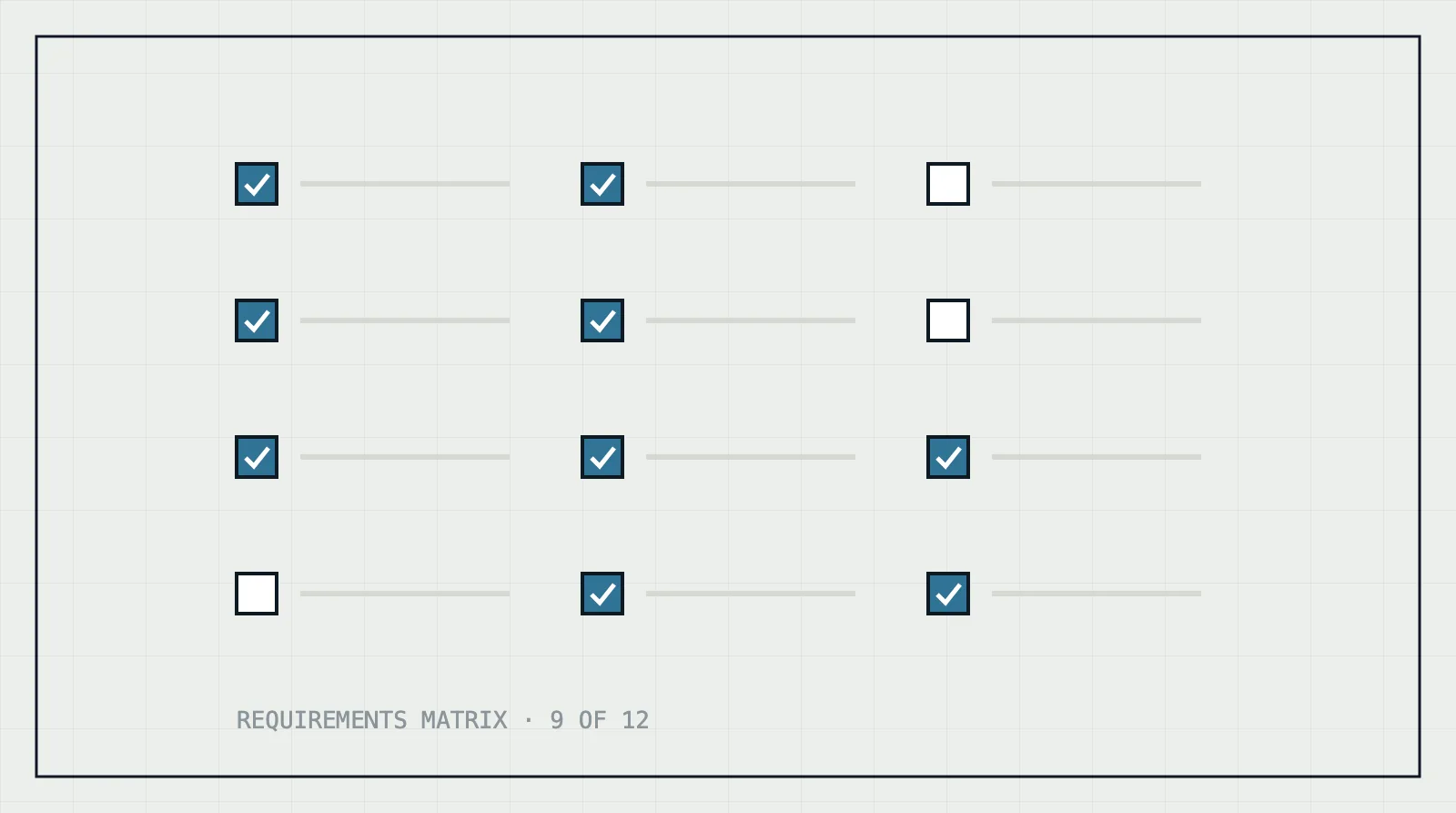
The list below comes from RFQs we have read from operators and ministries in the Pacific, the Caribbean and the Mediterranean, reduced to the items that actually change the buying decision. Nine of the twelve are usually enough for a given operator. The point is to decide which three you drop, on purpose, rather than discovering after the contract which ones the product never had.
- Multi-call voyages. A voyage is an ordered list of port calls, and a passenger books between any two of them. If the product's data model is a departure with one origin and one destination, every multi-stop sailing becomes a dozen products and the manifest never adds up.
- Seats per leg. Capacity is checked on each stretch between consecutive calls, and the tightest leg decides. Infants on laps do not take seats; unpaid holds do, until they expire.
- Published tariffs. Fares come from a tariff table the operator maintains, per mile or per port pair, with age bands and classes, versioned so that any fare charged on any date can be reproduced. The FSM Ship Tariff Regulations of 2003 are one example of what such a table looks like in law; most ministries have an equivalent.
- Counter payment with receipts. A booking can be held online and paid in cash at the agency or a government finance office, and the agent records the receipt number. The hold expires a set number of hours before departure.
- Manifests per call. For each port call: who boards, who disembarks, persons on board after departure. Exportable in the authority's format.
- Boarding that works offline. The boarding desk, on a wharf or a ship with no signal, scans tickets against a local copy of the manifest and syncs when it is back in range.
- Cargo. Bills of lading, consignee, weight and volume, freight charged from the same tariff. Not every operator needs it on day one; any operator that carries a sack of copra or a cooler of fish will need it by year two.
- White label. The passenger site, the tickets and the emails carry the operator's name, colours and domain, not the vendor's.
- Reports for donors and the authority. Passengers per voyage per leg, load factor, revenue per route, cash reconciled per agency per day, in a form a World Bank or ADB project officer can paste into a results framework.
- Accessibility. WCAG 2.2 AA on the passenger site, keyboard operation, screen reader labels, and a way to record assistance needs. The European Accessibility Act has applied to e-ticketing for passenger transport since June 2025; other jurisdictions are following.
- Data residency. The operator chooses where the database and its backups live, and the contract says so.
- Multilingual. The passenger site, tickets and messages in the languages of the islands, not only the vendor's.
What things cost over three years
There are three price models, and vendors who use different ones will present numbers that cannot be compared on the quote page. Convert everything to a three-year total before you look at anything else.
Per ticket. A percentage, typically 1.5 to 8 percent, or a fixed fee per booking, charged by tour platforms and aggregators. It looks free: no licence, no setup. It scales with your revenue, which is the problem. Take a service selling 40,000 tickets a year at an average fare of USD 18, a modest inter-island line. Revenue is USD 720,000. A 4 percent commission is USD 28,800 a year, USD 86,400 over three years, and the passenger often pays a service fee on top. Card processing is charged separately in every model.
Per month. A subscription, usually per operator or per vessel, from a few hundred to a few thousand dollars, plus a one-time implementation. The same operator paying USD 500 a month and USD 8,000 for implementation spends USD 26,000 over three years. Check what the subscription does not include: SMS, extra agency users, support hours, the reporting module.
Licence plus implementation. An annual or perpetual licence quoted on fleet size and modules, with implementation and training priced once. This is how the enterprise suites sell and how Supaferry sells. Annual maintenance on a perpetual licence runs at 15 to 22 percent of the licence price in most contracts. For a small operator, an annual licence usually lands between the subscription and the enterprise figure; for a ministry buying agency accounts, reporting and a dedicated instance, the implementation line is the larger part and the one to negotiate.
Whatever the model, add the things that are never on the quote: the gateway's card fees, SMS at local rates, the hardware for the boarding desk (a rugged Android device and a receipt printer per wharf), connectivity at the counter, and the staff hours for the parallel run. These are often half of the first-year cost.
Implementation in weeks, data ownership and exit
A configured product should be live in four to eight weeks from the day the operator hands over its documents. The documents are the same for any vendor: the port list with coordinates, each vessel's certified capacity per class, the schedule for the next ninety days, the tariff, the passenger questions the authority requires, the list of agencies and their staff, the logo and the receipt procedure. If a vendor cannot tell you which documents they need in the first meeting, they have not done this before.
A reasonable plan: week one, configuration of ports, vessels and tariff from the documents, and the operator checks a handful of fares against the paper table. Week two, agencies and users, passenger questions, branding. Week three, training for counter agents, the boarding officers and the dispatcher, two days each. Week four, a parallel run on one route: the ticket book keeps going, the system runs alongside, and the two manifests are compared after every sailing. Go live on that route, then the rest.
A custom build takes a year to the first version and never really finishes. The enterprise suites take six to eighteen months because they integrate with port systems, payment rails and existing back offices that a small operator does not have. If a vendor quotes you a year, ask what in your operation justifies it.
Data ownership is the clause most buyers forget until they want to leave. The contract should say in plain words that the bookings, passengers, manifests, tariffs and audit log belong to the operator; that the operator can export all of it at any time in an open format (CSV or JSON, with a documented schema) without asking the vendor; and that at the end of the contract the vendor hands over a final export and deletes its copy within a stated period. Ask where the database lives, where the backups go, and who at the vendor can read passenger data. A vendor that hosts in one region and backs up to another has already made a residency decision for you.
Write the exit into the contract on the day you sign it. It is the only day you have the leverage.
The questions to put in an RFQ
An RFQ that lists features gets brochure answers. An RFQ that asks for evidence gets usable ones. The questions below are phrased so that the answer is a demonstration, a document or a number.
- Show a voyage with five port calls and a booking between the second and the fourth. Show the seats remaining on each leg before and after.
- Load our tariff table and compute the fare for three port pairs we choose, in two classes and three age bands. Show the audit record of the computation.
- Hold a booking online, pay it at the counter with a receipt number, let another hold expire. Show the audit log for both.
- Print the manifest for the third call: embarking, disembarking, persons on board. Export it in our authority's format.
- Disconnect the boarding device from the network and board twenty passengers. Reconnect and show the manifest.
- Which of the twelve requirements are live today, which are on a dated roadmap, which are not planned? One line each.
- Where is the database hosted, where are the backups, and can we choose another region? What is the export format and how long does a full export take?
- Give us the three-year total for our volume, with every line item, including the ones you charge through third parties.
- Name two operators of similar size we can call, and one that has left you.
- What do you need from us, and how many weeks to go live? What happens if we miss a week?
References and demos
Call the references, and ask the reference about the thing the vendor was least keen to show. Ask how long implementation actually took, what broke in the first month, and how the vendor handled the first request for a feature that was not in the contract. Ask whether they have ever exported their data.
Then run the demo yourself. A scripted vendor demo with the vendor's data shows the product at its best; your data shows it as it is. Send your schedule, your tariff and a hundred names a week before, and ask the vendor to load them. In the room, operate the counter screen yourself, with the agent who will use it standing next to you. Then ask to board three hundred people. The vendor should produce three hundred tickets, hand you the scanner, and let you board them while the clock runs. You will learn more in those twenty minutes than in the whole proposal: whether the scanner reads a crumpled ticket, what happens on a duplicate, how fast the list refreshes, and whether the manifest afterwards says three hundred. If the vendor says the demo environment cannot do that, you have learned something too.
Supaferry offers a configured demo under the operator's name within a week of receiving a schedule and a tariff, at no cost, precisely because the question above is the one that matters. Any serious vendor in the small-operator segment should do the same.
A scoring matrix you can copy
A matrix turns a room full of opinions into a decision that can be defended to a board or a donor. Build it before the first demo, not after.
- List the rows: the twelve requirements above, plus whatever is specific to you (a local payment method, an integration with the ministry's finance system, a particular report). Keep the list under twenty rows.
- Mark each row as a gate or as weighted. A gate is a must-have: a vendor that fails it is out, whatever the total. Per-leg seats and manifests per call are gates for almost every island service; cargo and multilingual rarely are.
- Give each weighted row a weight of 1, 2 or 3. Decide the weights before you see any product, and write down why.
- Score each vendor on each row from 0 to 2. Zero means not available. One means on a dated roadmap, or available with a workaround you have seen. Two means shown working in a demo with your data.
- Only a demonstration earns a two. A proposal that says yes earns a one at most, and a reference call that confirms it in use can raise it.
- Multiply score by weight, add up, divide by the maximum possible, and show the result as a percentage.
- Keep cost out of the score. Put the three-year total in its own column next to the percentage, so that the board sees both and decides the trade-off openly instead of hiding it inside a weight.
- Have at least three people score independently: an operations person, a finance person and whoever runs the counter. Where two scores differ by more than one point, discuss and record the reason.
- Record evidence for every two: a screenshot, a line in the demo minutes, the name of the reference.
- Attach the matrix to the contract as the acceptance checklist. At go-live, every row scored two must be demonstrated again on the production system.
Common mistakes
- Buying for tourists when the passengers are residents. Marketplace reach and dynamic pricing are worth nothing on a route people take to see a doctor.
- Comparing the licence line and forgetting the commission. Per-ticket pricing is the most expensive model for any operator with real volume.
- Letting the vendor drive the demo with their own data.
- Specifying technology instead of outcomes. An RFQ that demands a particular database or framework excludes good products and does not guarantee a good one.
- Counting a roadmap feature as present. If it is not live, it scores one, and the contract should carry a date and a remedy.
- Ignoring the boarding desk. The counter and the wharf are where the system is used two hundred days a year; the passenger website is where it is demonstrated.
- Not involving the people who will use it. A counter agent and a ship's master will find in an hour what a procurement committee misses in a month.
- Skipping the parallel run. Two weeks of double work is cheaper than one sailing with no manifest.
- Choosing the biggest vendor as the safe choice. The safe choice is the one that fits, that you can leave, and that answered the questions.
- Signing without an exit clause.
None of this is difficult. It is a few weeks of work, most of it spent preparing documents the operator should have anyway. The reward is a system that counts seats the way the master counts them, prices fares the way the regulation prices them, and produces the manifest as a by-product of selling tickets, at a cost the board can explain. That, and not the length of the feature list, is what a good booking system is for.
Questions people ask
- Do we need a ferry-specific system, or will a tour platform do?
- If every sailing is a single crossing between two ports and most passengers pay by card, a tour platform may do for a while. The moment a sailing calls at a third port, or an agency sells for cash, the departure model breaks and someone maintains the manifest by hand. Check the twelve requirements against your real schedule before deciding.
- How long should implementation take?
- Four to eight weeks for a configured product, counted from the day you hand over the port list, capacities, schedule, tariff and agency list. A year means a custom build or an enterprise integration. Ask what in your operation justifies the time.
- What is a fair price for a small operator?
- Convert every offer to a three-year total at your ticket volume, including commission, card fees, SMS, hardware and implementation. For an operator selling tens of thousands of tickets a year, a licence or a subscription is usually cheaper than a per-ticket model. Below ten thousand tickets the order can reverse.
- What should the demo prove?
- That the product handles your schedule and your tariff, not the vendor's. Send both in advance, operate the counter yourself, and board three hundred passengers with the scanner, offline if your wharves have no signal. Score only what you saw.
- Who owns the data?
- The operator, and the contract must say so: export at any time in an open format, a final export and deletion at the end, a stated hosting region for data and backups. Negotiate this before signing. Afterwards you have no leverage.
- Is a custom build ever the right choice?
- When nothing on the market models the operation and the operator has a permanent technical team to own the code for a decade. Both conditions together are rare. Most custom builds in this sector are replaced within five years, often by the next donor project.