The ticket office: counter sales, cash and the end of the day
· 11 min read
How a maritime ticket office sells at the counter, holds seats without money, records receipts and invoiced travel, and closes the day so a treasury or an auditor can follow every dollar.
Most of what is written about selling ferry tickets is about the website. The counter gets a paragraph, usually to say that it still exists. On the services this journal is about, small ferry lines and inter-island shipping, the counter is where most of the money arrives, in cash, from people who do not have a card and would not trust a payment page if they did. That money is public money, or it is the operator's only income, and the person who counts it at five o'clock is the one an auditor will ask about a year later.
This article is about the counter: how a seat is reserved and paid for, what a receipt is and who issues it, how a government department travels on an invoice instead of cash, and what the end of the day looks like when it is done properly. None of the procedures are new. Treasuries wrote them for stamp counters and customs houses long before anyone sold a ticket online. What a booking system adds is that the ledger writes itself, line by line, and nobody can rewrite it afterwards.
Why the counter still matters
Four kinds of passenger keep the counter open. The first pays in cash because cash is what there is. On the outer islands of Micronesia, Kiribati or the Marshalls there is no bank branch and no card terminal, and a family travelling to the state centre carries the fare in notes. The same is true in much of eastern Indonesia, where the port counters still take most of their sales in cash, and in the Philippine provincial ports, where the ticket booth and the terminal fee window sit side by side. The second passenger has a card but will not use it online: the elderly on Lipari or Salina who have taken the hydrofoil to Milazzo for fifty years and buy the ticket from the same biglietteria, or the pensioner on Barra who phones the port office. The third is the relative: a cousin on the main island pays for a passenger who is still on the outer island with no connection at all. The fourth does not pay, because a government department is paying for them, and what they carry to the counter is a travel authorisation with a number on it.
A booking system that treats the counter as a lesser channel, a back door to the website, gets all four wrong. The counter needs its own flow: reserve, collect, record who collected, print, and reconcile. The rest of this article follows that order.
The hold: reserve now, pay before a deadline
A hold is a booking without money. Someone phones from Nukuoro to reserve four deck places for the family on the next Southern Run; a school asks for twenty places for a trip in three weeks; a passenger stops at the counter on the way to the Finance Office with the cash still in a pocket. In all three cases the seats must be taken out of inventory at once, so that the next sale does not take them, and must come back into inventory automatically if the money never arrives.
The rules of a hold are simple and should be written down once, in the operator's settings, not decided case by case. A hold carries the passengers' names, the voyage, the origin and destination calls and the fare, exactly like a paid booking, and it carries a deadline. The deadline is the earlier of two things: a number of hours after the hold was placed, and a number of hours before the ship leaves. Supaferry calls the second figure the agent hold window, and an operator who sets it to 48 is saying that no unpaid seat may block the manifest in the last two days before departure. When the deadline passes the system releases the seats, marks the booking expired and writes a line in the log saying so. Nobody has to remember.
Three consequences follow. A hold is not revenue and must never appear in the cash report as if it were. A hold is visible on the manifest as pending, so the dispatcher sees the true picture of the voyage. And a hold is closed by exactly one event: a receipt number entered against it, which turns it into a confirmed booking and prints the ticket. An SMS to the passenger the day before the deadline costs a few cents and saves a seat that would otherwise be lost to both sides.
A hold is a promise with a deadline, not a sale.
Receipts: who issues them and what goes on the ticket
On a government service the counter usually does not issue the receipt. The passenger pays at the Finance Office or the Treasury window, receives an official receipt from a pre-numbered book or a cash register, and brings it back to the counter. The agent types the receipt number into the booking, the hold becomes a confirmed ticket, and the number is printed on the ticket itself. On a private line the counter issues its own receipt under whatever fiscal rule applies: the scontrino or the electronic invoice in Italy, the factura simplificada in Spain, the official receipt of the revenue bureau in the Philippines. In both cases the principle is the same: one numbered receipt, one booking, the number stored on the booking and visible on the ticket, never reused.
The number matters more than the paper. It is the link between three records kept by three different people: the receipt book or register at the finance window, the booking in the system, and the deposit at the bank. If a receipt number appears on two bookings, or a booking is confirmed without one, the system should refuse, and the day's report should show the range of numbers used and any gap in it. A gap is not a crime; a voided receipt happens every week. An unexplained gap is what an auditor writes down.
Cargo follows the same path. A bill of lading for fifteen cartons to an outer island is paid at the same window, takes a receipt number from the same book, and appears in the same day's ledger as the tickets, one line among them. Operators who keep cargo in a separate notebook lose the ability to reconcile the counter in one pass.
Invoiced travel for departments
A nurse going to a dispensary, a teacher returning to post, an inspector sent to count a harvest: public employees travel on the department's money, and the department does not send cash. It sends a travel authorisation, a form with a number, the traveller's name, the destination, the dates and the signature of someone who may commit the budget. The counter records that number in the place where the receipt number would go, marks the booking as invoiced, and issues the ticket. No money moves at the counter.
At the end of the month the system produces a statement per department: every ticket issued against its authorisations, with dates, passengers, voyages and fares. Finance raises the invoice or the journal transfer, and the department settles it from its own vote. The same mechanism serves a donor programme that pays for the travel of its field staff, or a company with a standing account at the line. Two controls matter: the name on the authorisation matches the passenger on the ticket, and invoiced amounts are listed in the day's report but never counted as cash. A counter that mixes the two will show a shortage every month and will not know why.
Who took the money
Every line in the ledger has a name on it. Not a counter, not a shift: a person, logged in under their own account, with the time to the second. Shared logins are the most common finding in a ticket office audit and the easiest to fix. Two agents at one window are two accounts and two drawers, or two sessions on one drawer with a documented handover. A supervisor who overrides a fare or approves a refund does it under their own name, and the override is a line in the log like any other.
The log is append-only. A booking is not edited; it is cancelled and a new one is created, and both remain visible. Supaferry writes an audit entry for every state change on a booking, with the actor, the action, the previous and the new values and a reason, and no one can alter the entry afterwards, including the operator's own administrator. This is the feature an auditor asks about first, and it is worth testing in any system before buying it: find a cancelled booking, find who cancelled it, find what it looked like before.
The end of the day
The close is a procedure, not a feeling. It is the same every day, it is done by the agent who sold, and it is checked by someone who did not. In order:
- Stop selling, or hand the window to the next agent with their own drawer. A day report belongs to one person.
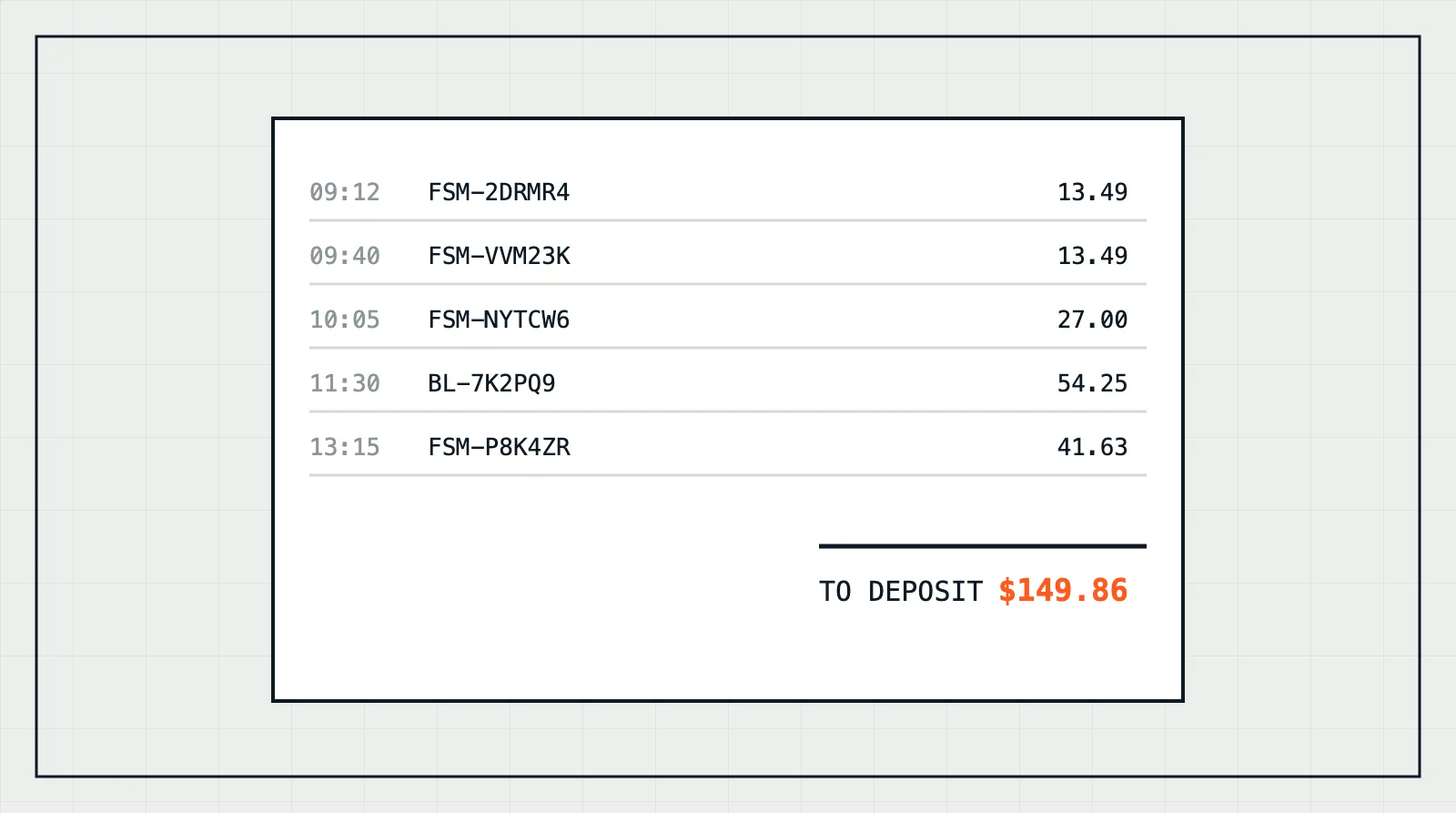
- Print the agent's day from the system: every sale, hold, expiry, invoice and refund, in time order, with receipt numbers and amounts. The report ends with four figures: cash received, refunds paid in cash, net cash to deposit, and invoiced amounts for information.
- Count the drawer. Notes by denomination, coins, cheques if any. Subtract the opening float. Write the figure down before looking at the system's figure.
- Compare. If the two match, sign. If they do not, the difference is a line in the report, over or short, with an explanation, and the supervisor signs that line too. A shortage is never made up from the agent's pocket and an overage is never kept back; both go on the record.
- Print the deposit slip: date, counter, agent, the receipt number range, the net cash by denomination, the amount in words, and two signature boxes, one for the agent and one for the supervisor or the finance officer who receives the cash.
- The cash goes to the bank or the treasury intact, the next morning at the latest, and the stamped copy of the deposit comes back and is filed with the slip.
Two rules are worth stating on their own. Refunds are negative lines, with the original booking reference, the reason and the approver, and they reduce the net to deposit; where the treasury's rules forbid paying out of takings, the refund is paid by voucher from the finance office instead, and the counter line records that no cash moved. Invoiced tickets are listed on the report, with their authorisation numbers, and they are not on the deposit slip, because there is nothing to deposit.
The deposit slip is the only document that connects the ship's manifest to the bank statement.
Separation of duties
Three roles, three people where the office is large enough, three hats worn at different times where it is not. The seller takes the money and issues the ticket. Finance receives the deposit, approves refunds and raises invoices. The auditor reads everything and writes nothing. The seller cannot approve their own refund; finance cannot issue a ticket; the auditor's account has no buttons.
A two-person outer-island agency cannot staff this, and the answer is not to pretend. It is compensating controls: a supervisor at the state centre reviews every agent's day within the week, the receipt sequence is checked against the report, the bank stamp is matched to the slip, and someone turns up once a month without warning to count the drawer at eleven in the morning. The system makes this cheap because the reports already exist.
Common frauds, and how the records close them
None of these are hypothetical. Every ferry line that has been audited has found at least one.
- The unrecorded sale. A passenger pays cash, boards on a hand-written slip, and the money never enters the ledger. Closed by boarding against the system only: the desk scans the ticket, and a passenger without a booking is counted on the manifest as a discrepancy that the master signs.
- The post-departure cancellation. A ticket is sold, the passenger travels, and the booking is cancelled afterwards with the cash kept. Closed by the boarding scan: a used ticket cannot be cancelled, and the log shows the sequence.
- The fare substitution. An adult pays the adult fare and the ticket is issued as a child or a free infant; the difference disappears. Closed by printing the fare class and the age band on the ticket and the manifest, and by the ratio report: an agent whose child fares run at twice the counter average is a question, not an accusation.
- The fictitious refund. A refund is recorded against a booking nobody asked to cancel. Closed by requiring a second account to approve any refund, and by notifying the passenger at the phone number on the original booking.
- The lapping shortage. Today's cash covers yesterday's gap, and the gap rolls forward for months. Closed by depositing intact every day and matching every deposit slip to a bank stamp within the week.
- The blocked seats. Holds placed under invented names on a full voyage, released at the last minute to friends or resold. Closed by the hold deadline, by the holds-placed and holds-expired counts per agent on the day report, and by the log.
- The altered receipt. A receipt written for one amount and entered for another. Closed when the receipt number, the amount and the booking are stored together and the finance window's own total for the day is compared to the counter's.
- The cargo without paper. Freight carried on a word and a favour. Closed by the bill of lading sharing the receipt book and the day's ledger with the tickets, and by the cargo manifest the master signs.
An auditor does not ask whether you trust your agent. They ask what you would see if you could not.
Reports per state and per agent
The ministry, the state treasury and the donor each want a different cut of the same data, and all of it should come from the ledger without anyone retyping. Per agent and per day: number of sales, cash, refunds, net deposited, invoiced, holds placed and expired, receipt range, deposit slip number, bank reference. Per counter and per month: the same, summed, with every over or short line listed. Per state or per route, for the ministry's quarterly return: passengers and revenue by class and by voyage, invoiced revenue by department, cargo tonnage and freight. For a donor that funded the vessel or the service: load factor per leg and revenue per voyage, which are the figures the subsidy agreement names.
Supaferry's back office produces the agent day report and the deposit slip as PDFs with the operator's own branding and exports every list as CSV; the reconciliation view shows, for any date range, receipts recorded against cash deposited and flags the days where the two differ. The format is not the point. The point is that the same numbers appear on the ticket, in the day report, on the deposit slip and in the quarterly return, because they were entered once.
One agent's day
Read the ledger again and notice what it does not need: a notebook, a calculator, a memory. Every figure on the deposit slip can be traced to a receipt, and every receipt to a passenger who will appear on a manifest or a carton that will appear on a cargo list. The refund is visible as what it is, the hold that expired cost nobody anything, and the Department of Education's $97.02 will appear on its monthly statement, not in the bank.
Setting up a counter: a checklist
- Decide who issues receipts, the counter or a finance window, and where the numbered series comes from.
- Create one account per person. Remove the shared login on the first day.
- Set the hold rules: hours after placement, hours before departure, and who may extend a hold.
- List the departments and programmes that may travel on invoice, with the format of their authorisation numbers.
- Write the refund rule: who approves, whether cash leaves the drawer or a voucher is raised, and the cut-off before departure.
- Fix the opening float and the deposit routine: which bank or treasury, by when, who signs.
- Agree the over or short tolerance that triggers a supervisor review, as a figure, not a feeling: $5.00 or one percent of the day, whichever is lower.
- Schedule the surprise count and the monthly sequence check.
- Keep a numbered paper ticket book for the days the connection is down, with the series reserved in the system so the entries can be keyed afterwards without a collision.
- Decide the retention period for reports, slips and bank stamps; seven years is the usual figure in public finance rules.
A counter set up this way is not slower than the notebook it replaces. It is faster at five o'clock, which is when speed matters, and it is the only version of the counter that a treasury, a ministry or a donor will accept without sending someone to count it themselves.
Questions people ask
- What happens at the counter when the connection is down?
- The agent sells from a numbered paper ticket book whose series is reserved in the system, collects the receipt number as usual, and keys the entries when the connection returns. The day report then shows those entries with their paper numbers, so the deposit still reconciles. A boarding desk that works offline reads the same ticket codes.
- Can refunds be paid in cash from the drawer?
- Only if the operator's or the treasury's rules allow it, and then as a negative line with the original booking reference, the reason and a second person's approval. Many public finance rules require takings to be deposited intact, in which case the refund is paid by voucher from the finance office and the counter records that no cash moved.
- How long should a hold last?
- Long enough for the passenger to reach the finance window and short enough not to block seats on a full voyage. A common setting is 48 hours after placement and no hold inside the last 24 to 48 hours before departure. The rule lives in the operator's settings and the system enforces it, releasing the seats and logging the expiry.
- What must the deposit slip contain?
- Date, counter, agent, the range of receipt numbers covered, the net cash by denomination, the amount in words, and two signatures: the agent who sold and the supervisor or finance officer who received the cash. Invoiced amounts and refunds paid by voucher do not appear on it. The bank's stamped copy is filed with it.
- Do invoiced tickets count as revenue on the day?
- They are revenue for the operator's accounts, but not cash for the counter. The day report lists them with their authorisation numbers so the ticket count and the manifest are complete, and the monthly statement per department is what finance invoices. Mixing them into the cash figure produces a shortage that does not exist.
- What does an auditor ask for first?
- Usually three things: the list of users and whether logins are shared, a cancelled booking with the record of who cancelled it and what it looked like before, and a week of deposit slips matched to the agent day reports and the bank stamps. A counter that can produce these in ten minutes has passed most of the audit.