How ferry fares are built: per-mile tariffs, age bands and residents' discounts
· 20 min read
Regulated and commercial ferry pricing explained with real tariffs, and why a fare calculator that stores rules beats a price list per route pair as soon as a ship calls at more than two ports.
Ask three people what a ferry ticket costs and you get three different questions back. The passenger wants a number. The operator wants to know which tariff applies, who is travelling, how far, in which class, and what they are carrying. The auditor wants to know why that number and not another, and whether the same inputs would give the same number next month. A fare is not a price. It is the result of applying a set of rules to a journey, and the rules are the thing worth understanding.
This article walks through the rules ferry operators actually use: regulated per-mile tariffs, flat fares, age bands, residents' discounts, minimum fares, extras and rounding. It then shows why a table with one price per route pair stops working as soon as a ship calls at more than two or three ports, and how a fare calculator stores the rules once and applies them to any journey. The examples come from the Pacific, the Canary Islands, Italy and Greece, because each shows a different kind of rule.
Regulated and commercial pricing
Ferry fares are set in one of two ways. On a commercial route the operator chooses the price and moves it with demand. A Saturday crossing from Piraeus to Mykonos in August costs more than a Tuesday in November, booking early is cheaper, and the operator may run three or four fare classes with different refund conditions. Yield management, as the airlines call it, is legal and normal wherever several operators compete for the same passengers.
On a regulated route the price is set or capped by an authority and the operator applies it. This is the case wherever the ship is the only link and the public pays part of the bill: the government ships of Micronesia, Kiribati and the Marshall Islands, Scotland's Western Isles under the Road Equivalent Tariff, Norway's county ferries, the Greek unprofitable lines served under public service contracts, the Italian minor islands, the Canary Islands' interinsular crossings. The authority publishes a tariff, in a regulation or in the service contract, and the operator's job is to charge exactly what the tariff says, to everyone, and to be able to prove it afterwards.
Most operators live in between. A regulated base fare with commercial extras; a commercial fare with a legally mandated residents' discount; a contract that fixes the fare for residents and leaves visitors to the market. The fare rules have to handle both at once, and the second half of this article is about how.
What a published tariff looks like
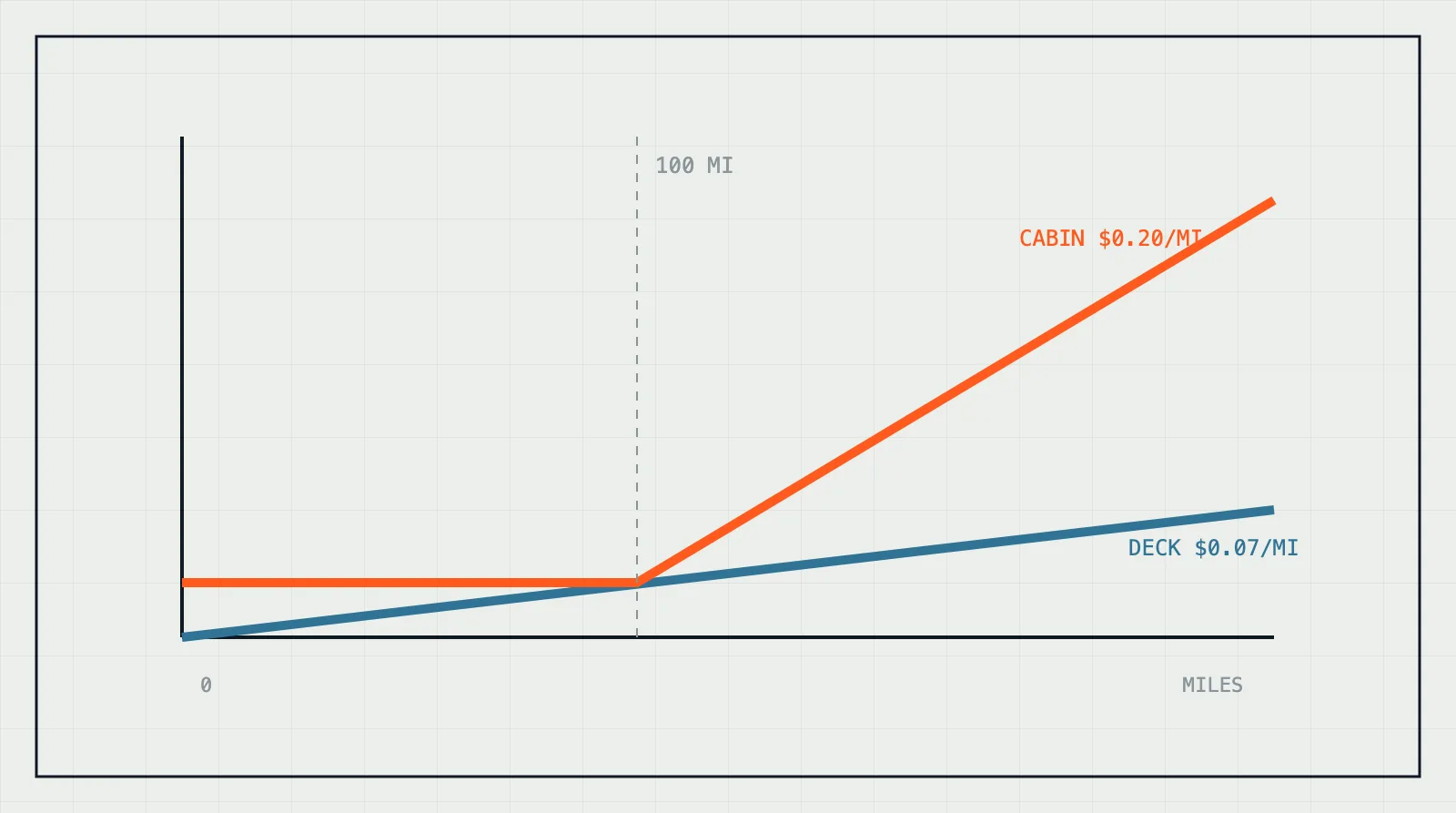
A regulated tariff is a short document. The FSM Ship Tariff Regulations of 2003, which still govern the national field trip ships of the Federated States of Micronesia, are a useful example because they are public and compact. Part 3 prices passenger fares point to point by distance. Deck passage costs $0.07 per mile. Cabin passage costs $0.18 per mile for journeys under 100 miles, with a minimum of $13.00, and $0.20 per mile from 100 miles. Children from 4 to 12 pay half; children under 4 travel free. Two packages of personal baggage are free; the rest is cargo and goes on the cargo tariff. A table at the back gives the distances between the four state centres: Pohnpei to Kosrae 319 miles, Pohnpei to Chuuk 385, Pohnpei to Yap 1,210, Chuuk to Yap 842, Kosrae to Chuuk 687, Kosrae to Yap 1,515.
That is the whole passenger tariff: two rates, one threshold, one minimum, two age bands, a free allowance and a distance table. It covers every journey the ships make, including the ones to outer islands whose distances are not in the table, because the rule is per mile and the miles can be measured.
Compare it with three European arrangements that work differently.
- Spain, Canary Islands. Fares on the interinsular crossings are commercial, but residents of the islands are entitled to a discount of 75 per cent on the fare, funded by the State and the regional government under Real Decreto 1316/2001 and its amendments. The discount applies to the fare, not to port charges or taxes, and the passenger's residence is checked at booking against the municipal register through the SARA system, so the ticket is issued at the discounted price and the operator claims the difference back. Large families get a further reduction. A visitor pays the full fare on the same deck of the same ship.
- Italy, territorial continuity. The State and the regions sign public service contracts with the operators serving Sardinia, Sicily and the minor islands. The contract fixes a fare schedule, with a lower fare for residents and often for workers and students, a higher fare for everyone else, and a subsidy for running the route at those prices. Regione Siciliana's contracts for the Aeolian, Egadi and Pelagie islands are the familiar case: a resident of Lipari pays a fraction of what a summer visitor pays for the same hydrofoil seat.
- Greece, public service routes. The Ministry of Maritime Affairs tenders the unprofitable lines, mostly to the small Aegean islands, and the contract fixes the fare and the discounts the operator must grant: children, students, people with disabilities, large families, each with a percentage set by law and a document that proves it. Since 2018 the transport equivalent scheme refunds island residents part of their fare after the journey through a separate claim, which is a reminder that a discount can be applied at sale or after it, and the fare rules must know which.
The four arrangements look different and share a structure. Each has a base fare that depends on the journey, a set of reductions that depend on who is travelling, a list of extras, and a rule about what is included. A fare calculator is a way of writing those four things down once.
A fare is not a price. It is the result of applying rules to a journey, and the rules are what the auditor will ask to see.
Distance: along the voyage, and which mile
A per-mile tariff raises two questions that a flat fare never does: how far, and measured how.
The FSM regulation says point to point, and the practice has always been to read that as the distance the ship actually sails between the passenger's embarkation and disembarkation, which on a multi-call voyage is the sum of the legs. A passenger from Pohnpei to Kapingamarangi on the Southern Run sails via Sapwuahfik and Nukuoro, and pays for the miles via Sapwuahfik and Nukuoro, because that is the service provided. The great-circle distance from Pohnpei straight to Kapingamarangi is about 471 miles; the route via the two atolls is about 504. On deck that is $2.31 of difference, in a cabin $6.60. Small, but a tariff that is applied inconsistently is a tariff that cannot be audited, so the rule has to be fixed and written down.
Published distances win over computed ones. Where the regulation prints a figure, that figure is the law, and a calculator must use it even if the coordinates say otherwise. Where it prints nothing, the calculator computes the great-circle distance between the two ports' coordinates for each leg and sums the legs. The operator can also enter a measured route distance for a pair, for instance the real track around a reef, and that then wins over the computed one. Three sources, one order of precedence: regulation, operator-entered, computed.
Then the mile. A nautical mile is 1,852 metres; a statute mile is 1,609. The FSM distance table reads as statute miles, and the difference between the two is 15 per cent of the fare, so a tariff that only says mile needs a decision recorded next to the rates. The same applies to any tariff written in kilometres applied to a chart measured in nautical miles.
Who is travelling: age bands, residents and the proof
Every tariff reduces the fare for some passengers. The common bands are age, residence, status (student, worker, disabled, military) and family size. For each band the calculator needs three things: the factor or amount, the condition, and the proof.
Age bands are the simplest and still cause arguments. The FSM rule, half fare from 4 to 12 and free under 4, needs a date of birth and a date to compare it with. Is the child's age taken on the day of booking or the day of sailing? A child who turns 13 between the two can be charged either way, and the operator must pick one rule and apply it everywhere. The defensible answer is the date of travel, because that is when the service is provided, and the booking form must ask for a date of birth rather than a tick box that says child. Most European operators use 4 to 11 or 2 to 11 for children and 0 to 3 or 0 to 1 for infants, which shows that the bands are data, not a fixed part of the software.
Infants have a second property beyond the fare: they do not occupy a seat on the certificate of inspection, but they are on the manifest. The fare engine and the capacity engine read the same age band and draw different conclusions, which is one reason to define the band in one place.
Residents' discounts are harder because residence must be proved. Spain checks the municipal register online at the moment of sale; before SARA, the passenger brought a certificate from the town hall and the operator kept a copy for the subsidy claim. Italian contracts generally accept the identity card, which shows the municipality of residence. A Pacific operator may accept a home island declared on the ticket and checked by the agent who knows the family. Whatever the method, the calculator must record which band was applied and on what evidence, because the subsidy that pays for the discount is audited and the operator repays what it cannot justify.
Discounts combine, and the order matters. A resident child in the Canaries gets the child reduction on the fare and then the residents' discount on the result, or the other way round; the two orders give different numbers when the child reduction is a fixed amount rather than a percentage. Taxes and port charges are usually applied after all discounts and are not discounted. These are not details for a developer to guess. They come from the regulation or the contract and are written into the rule set.
The small rules
Extras and free allowances
Beyond the seat, a ferry sells meals, baggage above the free allowance, vehicles, bicycles, pets, cabin upgrades and, on cargo ships, the freight that travels with the passenger. The FSM tariff gives two free packages per passenger and charges a small fixed sum for each extra package, with anything heavier going on the cargo tariff by weight or volume. A Canary Islands operator prices a car by length band and a motorcycle flat, and a Greek PSO contract fixes the vehicle fare as it fixes the passenger fare.
Extras are the part of the fare most likely to be priced flat, per unit, with a maximum quantity, and most likely to be added at the counter after the booking was made online. They belong on the same quote as the fare, as separate lines, so that the ticket shows the passenger what was paid for what, and so that the daily cash reconciliation can separate fare revenue from meals revenue, which the authority and the donor usually want reported apart.
Rounding, minimums and currency
Three small rules decide whether two systems produce the same number.
- The minimum fare. The FSM cabin minimum of $13.00 means that a 60-mile cabin journey, which would cost $10.80 at $0.18 per mile, costs $13.00. The minimum applies to the adult fare before age reductions, so a child in that cabin pays $6.50, half the minimum, not half of $10.80.
- The threshold. At 99 miles a cabin costs 99 times $0.18, which is $17.82; at 100 miles it costs 100 times $0.20, which is $20.00. The rate changes for the whole journey, not only for the miles above the threshold, and the fare jumps by $2.18 for one extra mile. That is what the regulation says, and a calculator must reproduce it rather than smooth it. A distance of 99.6 miles has to be rounded one way or the other before the threshold is tested, and that rounding rule is part of the tariff.
- Cents and lines. Money is kept in integer cents, never in floating-point dollars. Each line of the quote, adults, children, infants, each extra, is rounded to the cent on its own, and the total is the sum of the rounded lines. Rounding the total instead of the lines produces a ticket whose lines do not add up to its total, which is the first thing an auditor notices.
Currency is one per operator in a regulated tariff, and the calculator should refuse to mix. Operators who sell in two currencies, as some Caribbean lines do, keep one tariff currency and publish an exchange rule, which is itself a rule with an effective date.
From a fare table to a rule set
Why a fixed fare table explodes
The alternative to rules is a table: one row per origin, destination and class, with the adult fare in it. For a two-port crossing it is one row per class and nobody needs a calculator. The trouble starts when the ship calls at more than two ports.
A voyage with seven calls has 21 origin and destination pairs. With two classes that is 42 fares; with three age bands written out, 126 numbers; if the fare differs by direction, double it. The Pohnpei Southern Run, out to Kapingamarangi and back, is seven calls. A network of 25 ports, which is what a Pacific state with outer islands has, is 300 pairs and 600 class fares before age bands. Every time the regulation changes a rate, every number changes. Every time a new island is added to a run, a new row is needed for every other port it can be paired with, and someone has to compute it by hand from the distance, which is the calculation the table was supposed to avoid.
Tables also hide errors. A fare of $34.90 in a cell is just a number; there is no way to tell whether it was computed with the right distance, the right rate or the right mile until someone recomputes it. A rule set is checkable: the distance, the rate and the band are visible on every quote.
Fixed fares are still needed. A schedule approved with its own price list, a promotional fare, a route where the contract names a figure: each overrides the computed fare for a pair. The right design keeps the table as an exception list on top of the rules, not as the primary source. A fixed fare for a pair wins when it exists, and the per-mile tariff applies everywhere else. The exception list is short and is read by a person; the rules cover the rest.
Twenty-one pairs for seven calls, and every one of them changes when the rate does. A tariff is a rule, and it should be stored as one.
How a calculator stores the rules once
A fare calculator for a ferry operator is a small set of records and one function.
- Tariff rules: for each class, the rate per mile, any threshold at which the rate changes, and the minimum fare, with an effective date.
- Distances: the published pairs from the regulation, the operator's measured routes, and the coordinates of every port for the fallback.
- Fixed fares: an exception list of origin, destination, class and adult fare, each with an effective date and a note saying where it comes from.
- Passenger bands: the age limits, the residents' rule, the other categories, each with its factor, its condition and the proof required.
- Extras: a catalogue of items with unit price, unit label and maximum quantity, plus the free allowance.
- Policies: the unit of distance, the rounding rule, the order in which reductions apply, how taxes are treated, and the currency.
The function takes a voyage, an origin call, a destination call, a class, a list of passengers with dates of birth and residence, and a list of extras, and returns a quote: one line per passenger type with the unit fare and the count, one line per extra, and a total. The miles sailed are summed over the legs between the two calls. The adult fare is the fixed fare for the pair if one exists, otherwise the tariff over those miles. Each passenger line is the adult fare times the band factor, rounded. The quote records the version of every rule it used.
Supaferry's fare engine is built this way. The tariff rules, the distance table, the fixed-fare list, the age bands and the extras catalogue are operator settings, edited in the back office and validated by the same schema on the server and in the browser. The quote function is a pure piece of shared code with a test file next to it; the booking service calls it, the public site calls it to show the fare before the passenger commits, and the agency counter calls it with the same inputs and gets the same number. Nothing in a route or a page computes a price on its own. When a regulation is amended, the change is a new rules record with a new effective date, and every fare from that date follows it while every ticket sold before still reproduces the old figure.
The same records express a commercial tariff. A fixed fare per pair with a residents' band at 0.25 and a child band at 0.5 is the Canary Islands. A fixed fare with a resident amount and a visitor amount is a Sicilian contract. A yield-managed route is a fixed fare list with many effective dates. The rules do not change shape; only their contents do.
Two worked examples
Pohnpei to Kapingamarangi
The Pohnpei Southern Run leaves Dekehtik wharf, calls at Sapwuahfik, Nukuoro and Kapingamarangi, and returns by the same islands. The regulation prints no distances for these outer islands, so the calculator takes the great-circle distance of each leg from the port coordinates: Pohnpei to Sapwuahfik 104 miles, Sapwuahfik to Nukuoro 208, Nukuoro to Kapingamarangi 193. A booking from Pohnpei to Kapingamarangi occupies all three legs: 504 miles.
Two adults, a child of 8 and an infant of 2, on deck, with three packages beyond the free allowance.
- Adult deck fare: 504 miles at $0.07 is $35.28. Two adults: $70.56.
- Child, 4 to 12, half fare: $17.64.
- Infant, under 4: $0.00, listed on the manifest, no seat counted.
- Three extra packages at $1.00: $3.00.
- Total: $91.20.
The same family in a cabin: 504 miles is above the 100-mile threshold, so the rate is $0.20 per mile and the adult fare is $100.80. Two adults $201.60, the child $50.40, the infant free, packages $3.00: $255.00. The $13.00 minimum is not reached because the journey is long. On the first leg alone, Pohnpei to Sapwuahfik, 104 miles, the cabin fare would be $20.80 and the deck fare $7.28, and a passenger who leaves the ship at Sapwuahfik pays those figures, not a share of the whole run.
Every line on that quote can be recomputed by hand from the regulation and the distance. That is the test a regulated tariff has to pass.
Tenerife to La Gomera
Now a commercial fare with a legal discount. Take the crossing from Los Cristianos to San Sebastián de La Gomera and suppose the published adult fare is 38.00 euros, a round figure in the range operators on that route have charged. A family of two adults and a child of 9, resident in La Gomera, with a car.
- The child reduction, say 50 per cent, applies to the fare: 19.00 euros.
- The residents' discount of 75 per cent applies to each passenger fare: adults 9.50 euros each, the child 4.75.
- The car is priced flat by length band, with its own residents' discount where the rule provides one; take 60.00 euros and 75 per cent: 15.00.
- Port charges and taxes are added after the discounts and are not discounted.
Passengers 23.75 euros, vehicle 15.00, then the charges. The operator will claim 116.25 euros of discounted fare back from the subsidy scheme and must be able to show, for each passenger, the residence check that justified it. If the same family were visitors, the lines would read 38.00, 38.00, 19.00 and 60.00: 155.00 euros. Same ship, same seats, a different set of band records.
The two examples use the same six kinds of record. One has a per-mile rule and no fixed fares; the other has fixed fares and a residents' band. Nothing else differs.
Transparency for passengers and auditors
A fare that is computed from rules can be shown as a computation. The quote the passenger sees before paying lists the miles, the rate, the class, the band for each person and each extra. The ticket repeats it. A passenger who thinks the fare is wrong can point to the line; an agent who is asked why a child paid $17.64 can answer from the ticket rather than from memory.
For the operator and the authority the useful property is reproducibility. Every rule record has an effective date and every quote records which versions it used, so the fare charged on any day can be recomputed and matched to the cash taken on that day. The daily reconciliation at the counter compares the sum of quotes to the sum of receipts; the monthly report to the ministry or the donor splits revenue by route, class and band from the same records. An auditor checking a residents' subsidy claim sees, for each discounted ticket, the band applied and the proof recorded.
Where fares are adjusted by hand, as happens at every counter in the world, the adjustment is a separate line with a reason and the user who made it, not an edit to the computed figure. The computed fare stays, the adjustment sits beside it, and both appear in the audit log. In Supaferry the counter can record a waiver or a correction this way, and the daily cash report shows the computed total, the adjustments and the receipts as three figures that must reconcile.
A fare table answers what. A rule set answers why, and why is the question that regulators, donors and passengers all end up asking.
None of this requires a particular product. An operator with a spreadsheet can keep the six kinds of record and a formula, and will be better off than one with a fare table. What a system adds is that the same rules are applied by the website, the counter and the boarding desk without anyone re-typing a number, and that the version history is kept whether or not anyone remembers to keep it.
Questions people ask
- What is a per-mile ferry tariff?
- A tariff in which the fare is a rate multiplied by the distance sailed, usually with a different rate per class and sometimes a minimum fare or a threshold where the rate changes. The FSM 2003 regulation is one example: $0.07 per mile on deck, $0.18 per mile in a cabin under 100 miles with a $13 minimum, $0.20 per mile from 100 miles. Per-mile tariffs are common where a government sets fares for a ship that serves many islands.
- How does a fare calculator know the distance between two ports?
- In order of precedence: a distance printed in the regulation, a route distance entered by the operator, or the great-circle distance computed from the two ports' coordinates. On a voyage with several calls the calculator sums the legs between the passenger's embarkation and disembarkation, so the fare reflects the route sailed, not a straight line.
- Do children pay half fare on ferries?
- It depends on the tariff. The FSM regulation charges half from 4 to 12 and nothing under 4; many European operators use 4 to 11 or 2 to 11 for children. The age should be taken on the date of travel and derived from a date of birth, and the band should be stored as data so the operator can change it without changing the software.
- How does the Spanish residents' discount work on ferries?
- Residents of the Canary Islands, the Balearic Islands, Ceuta and Melilla receive a 75 per cent discount on the fare on interinsular and mainland routes, funded by the State and, where applicable, the regional government. Residence is verified at sale against the municipal register through the SARA system, the ticket is issued at the discounted price, and the operator claims the difference from the scheme. Port charges and taxes are not discounted.
- Why not keep a price list per route instead of a calculator?
- Because the list grows with the square of the number of ports: seven calls give 21 pairs, 25 ports give 300, and each pair needs a figure per class and per band. Every rate change means recomputing every cell, and a cell cannot show whether it was computed correctly. A calculator stores the rules once and keeps fixed fares as a short exception list.
- Statute miles or nautical miles?
- Whichever the tariff says, and if it does not say, the operator must decide and record it. A nautical mile is 1,852 metres and a statute mile 1,609, a 15 per cent difference in every fare. The FSM distance table reads as statute miles.
- How are extras such as meals, vehicles and excess baggage priced?
- Usually flat, per unit, with a maximum quantity and a free allowance where one applies. They go on the quote as separate lines, so the ticket shows what was paid for what and the cash report can separate fare revenue from extras.