What a passenger manifest must contain
· 20 min read
What SOLAS III/27 and Directive 98/41/EC require, what island administrations add, how the manifest changes at every call, and how a booking system produces it from tickets and boardings.
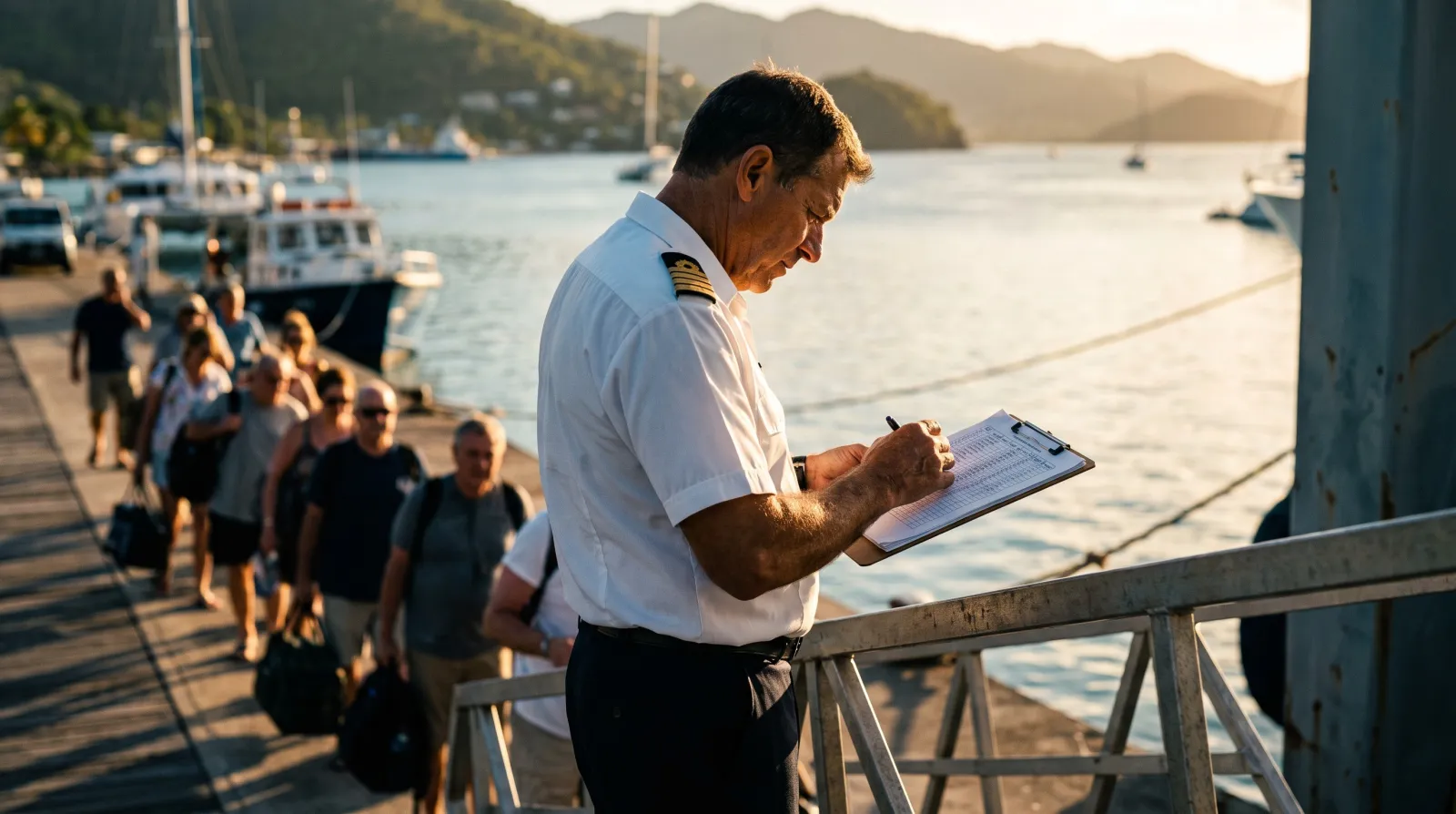
A passenger manifest is the one document a passenger ship produces for people who were never on board. The ticket is for the passenger and the receipt is for the accountant. The manifest is for the rescue coordination centre, the harbour master, the insurer, the consulate and, on the worst day, the coroner. It is usually finished in the last ten minutes before the lines are let go, by the busiest person on the ship, and if it is wrong nobody notices until the day it is the only record that matters.
This article sets out what a manifest must contain under the international and European rules, what island administrations add on top, how the document changes on a voyage that calls at several ports, who counts and who signs, what search and rescue services actually ask for, where paper ledgers fail, and how a booking system produces a correct manifest as a by-product of selling tickets. The worked example is a seven-call voyage carrying 300 passengers.
What the law asks for
The international rule is short. SOLAS chapter III, regulation 27 applies to passenger ships on international voyages and asks for four things. All persons on board are counted before departure. Details of anyone who has declared a need for special care or assistance in an emergency are recorded and given to the master before departure. The names and gender of every person on board, distinguishing adults, children and infants, are recorded for search and rescue purposes. And that information is kept ashore and made readily available to search and rescue services when they need it. The regulation says nothing about the format. A ledger satisfies it, provided the ledger is ashore and legible.
The European Union turned the same four ideas into a procedure. Directive 98/41/EC was adopted after the loss of the Estonia in September 1994, when the authorities could not say for days how many people had been on board or who they were. The directive applies to every passenger ship departing from a port in a member state, on domestic as well as international voyages, and it was tightened by Directive (EU) 2017/2109, which applies since December 2019. In its current form it asks for two separate things.
The first is the count. All persons on board, crew included, are counted before the ship departs. The number is communicated to the master before departure and recorded in the national maritime single window, or sent to the designated authority through AIS where the member state allows it. There is no distance threshold for the count. A ferry on a twenty-minute crossing counts its passengers the same as a ship bound for another country.
The second is the register of persons, and it applies to voyages of more than 20 nautical miles from the port of departure. For each person on board the operator records:
- surname and forenames,
- sex,
- nationality,
- date of birth (the 1998 text accepted an age category, adult, child or infant, or a year of birth; the 2017 amendment asks for the date),
- when the passenger volunteers it, any need for special care or assistance in an emergency,
- when the passenger volunteers it, a contact number in case of emergency.
These details are collected before departure and recorded in the single window within 15 minutes after departure. Before 2017 the operator kept them in its own system and had 30 minutes; the amendment moved the record to the authority's system and halved the time. The company must appoint a passenger registrar, a named person responsible for keeping the information and handing it to search and rescue services without delay. Member states may exempt regular services in sheltered waters under conditions the directive spells out, and several do for short island hops, but no exemption removes the count.
The directive was transposed everywhere by 1999 and 2000. Spain's Real Decreto 665/1999, the Italian decrees applied by the Capitanerie di porto and the United Kingdom's Counting and Registration of Persons on Board Passenger Ships Regulations 1999 all say the same thing in their own words, and the UK kept its rules after leaving the Union. Since August 2025 the European Maritime Single Window environment harmonises the data set the national single windows accept, so the same manifest file can be filed in Piraeus, Palermo and Las Palmas.
Outside Europe the picture is a patchwork, but the direction is the same. The Philippines requires a manifest with name, age, sex, address and emergency contact for every domestic passenger, filed with the Coast Guard before the pre-departure inspection. Indonesia requires one under its shipping law and has enforced it harder since the Lake Toba sinking of 2018. Pacific island administrations write the requirement into their shipping acts and port notices, and they add fields of their own.
What island administrations add
An island administration cares about more than search and rescue. The ship is the only link to the outer islands for weeks at a time, and the manifest is the only record of who travelled, so it ends up carrying the questions of every department that has no other way to ask them. The additions vary, but five come up on nearly every service we have looked at.
- Home island or village, and sometimes the island of destination even when it is not where the passenger disembarks, because the ship anchors off one island and the passenger continues by boat.
- Purpose of travel: medical referral, school, government business, church, family, trade. The health department uses it to track referrals to the state hospital; the education department uses it to count students going home at the end of term.
- Guardian for minors. An unaccompanied child needs a named adult responsible on board, or a named adult receiving them at the destination, with a contact. Several Pacific shipping notices refuse boarding to a minor without one.
- Identity document number for passengers crossing a state or national border, or for anyone when the ship is a government vessel and the fare is subsidised, so the subsidy cannot be claimed twice for the same person.
- A contact number or next of kin, which the EU directive makes optional and most island services make mandatory, because the person to call after an incident is usually on another island.
Yap State's shipping notices, to take one public example, require the passenger list to be lodged with the transportation office before the ship sails and to carry the home island and the purpose of travel, and the state uses the same list to allocate the subsidised fares the ship tariff provides. Caribbean inter-island services ask for passport numbers because almost every voyage is international. Indonesian regulations ask for an address and an identity card number. Scottish island services ask for nothing beyond the European set, because the crossings are regular and the directive's own list is enough.
Two conclusions follow. First, the manifest fields are not fixed by the ship or by the software; they are set by the administration the ship sails under, and they change when the administration changes its mind. A system where the passenger questions are configuration, not code, saves a rewrite each time. Supaferry stores the passenger and booking questions as a list of field definitions the operator edits, validates answers against that list, and stores nothing that is not on it, which is also what the privacy rules want. Second, every field added is a field that has to be protected, kept and eventually deleted, and the administration that asks for it should be able to say what it is for.
One voyage, seven calls: a worked example
Take a ship certified for 180 passengers and 18 crew on a morning run through the Cyclades: Piraeus, Syros, Tinos, Mykonos, Naxos, Ios, Santorini. Seven calls, six legs, 300 passengers booked over the day. The voyage runs far beyond 20 nautical miles from Piraeus, so the full register applies to every departure on it. The same shape appears on the Aeolian hydrofoil that calls at Vulcano, Lipari, Salina, Panarea and Stromboli, on the Canary Islands line that strings Tenerife, La Gomera, La Palma and El Hierro, and on every Pacific field trip.
A ledger kept per voyage lists 300 names. That number is true of nobody's safety. The ship never carries 300 people. What the master signs at each departure, and what the rescue centre needs if the ship is overdue, is the list of who is on board on the next leg, and that is a different list after every call.
The arithmetic is trivial. The difficulty is doing it in the time the law allows. At Syros the ship is alongside for twelve minutes. In that time 48 people walk off, 35 walk on, the gangway comes in, the count of 145 persons goes to the master before the lines are let go, and within 15 minutes after that the list of 127 passenger names has to be in the single window. A purser with a clipboard can count heads at the gangway. He cannot rewrite a 127-name list. So in practice the paper manifest filed at Piraeus stays the manifest of record all day, and it is wrong from the second call onwards.
On a Pacific field trip the same problem is slower but worse. The ship anchors off an atoll for six hours, passengers go ashore by boat, some come back, some do not, and others come out from the island with cargo. The number on board when the anchor comes up is known to nobody unless someone counted the boats. A multi-call voyage needs a manifest per call, with three lists: who embarked here, who disembarked here, and who is on board after the ship leaves. The last list is the one the master signs.
The voyage manifest is a record of sales. The departure manifest is a record of lives. A ship that calls at seven ports signs seven of them.
Who counts, who signs, who keeps the copy ashore
Three roles, often three people, sometimes one. The counter is at the gangway: on a ferry the purser or the chief officer, on an island ship whoever holds the clipboard, at an anchorage the boat coxswain. The count is of persons, not tickets: crew, children on laps, the agent's cousin riding for free, the two mechanics travelling with the generator. On an EU voyage the count is communicated to the master before departure; it is the master's number from then on.
The signer is the master. The persons-on-board declaration carries the master's name, the vessel, the port, the date and time of departure and the number of persons on board, often split into passengers and crew and, where the register applies, into adults, children and infants. On a multi-call voyage the master signs again at every departure. The signature is not a formality: in most jurisdictions the master is personally liable for sailing with more persons than the certificate allows, and the manifest is the document that proves the number.
The keeper ashore is the company's passenger registrar under the directive, or the agency or shipping office in a system that does not use the term. Whatever the title, the test is the same: can someone who is not on the ship produce the current list of persons on board, with the special-care entries, at three in the morning, within a few minutes of being asked. A copy locked in the agency safe fails that test. A copy on the ship fails it absolutely, because the ship is the thing that is missing. The port authority is usually a fourth party: the harbour master or coast guard receives the departure manifest as part of port clearance and keeps it for its own records.
The practical rule is that a departure manifest, once signed, is frozen. Corrections happen, a name misspelled or a passenger who was counted but had stepped off, but they produce a new version with a timestamp and a reason, not an edit to the signed one. A rescue coordinator working from a list needs to know which version the master had and when it changed.
What search and rescue actually asks for
A maritime rescue coordination centre that receives a distress alert, or a report of a ship overdue, asks the operator a fixed set of questions in a fixed order. How many persons are on board right now. How many of them are crew. Are there children and infants, and how many. Is there anyone who cannot evacuate unaided, where are they and what do they need. What nationalities, because consulates have to be told. And then, as the operation moves from rescue to recovery, the names, so survivors can be matched against the list and families told.
Each of those questions has a time attached. The count and the special-care list are needed in the first minutes, because they decide how many helicopters and which equipment. The names are needed within hours. Nationality matters on the first day. The purpose of travel and the home island matter to the administration afterwards, and to nobody during the rescue.
The cases that shaped the rules are all cases where the list was missing or wrong. After the Estonia the number on board was revised for weeks. When the KM Sinar Bangun capsized on Lake Toba in June 2018 the manifest listed 43 passengers; the search established that well over 160 people had been on board, with later estimates near 190, and the gap between the two numbers was the reason the rescue was planned at the wrong scale. The pattern repeats on small ships because a small ship's manifest is more often a courtesy than a count.
The rescue coordinator does not ask who bought a ticket. The coordinator asks who is on the ship now, and the answer has to come from the shore.
Where the paper ledger goes wrong
Paper is not the problem in itself; the practices around it are. The failures below are the ones that appear in every incident report and every audit of an island service we have read.
- Sold is not boarded. The ledger is copied from the ticket book, so it lists passengers who never turned up and misses the ones who paid cash at the gangway.
- Nobody is struck off. On a multi-call voyage the list grows at each call and never shrinks, so by the last leg it overstates the number on board by a factor of two or three.
- Infants are invisible. A child on a lap has no ticket, so it has no line, and the count of persons is short by the number of babies on board.
- Crew are a separate document, kept in a different drawer, so the total persons-on-board figure has to be assembled under pressure from two sources.
- Special care is a note in the margin, if it is anywhere, and the margin stays on the ship.
- The list stays with the ship. The only complete copy is in the purser's office, which is the one place a rescue coordinator cannot read it.
- No time stamp. A list dated with the day cannot say what the ship carried on which leg.
- Handwriting. A name that cannot be read is a name that cannot be matched to a survivor or a consulate.
- No reconciliation. The ledger's count and the gangway head count differ, nobody records both, and whichever is written on the clearance form becomes the truth.
A ledger that avoids all of these can exist. It is kept by a purser who counts heads separately, strikes names at every call, rewrites the list before each departure and radios a copy ashore. That purser works on a small number of ships. The point of a system is to make the rest of the fleet as good as that purser without depending on him.
From bookings to manifest
A booking system that models voyages correctly produces the manifest without a separate step, because every piece of the manifest is already in the booking. The flow has four stages.
- Booking. A booking references a voyage, an embarkation call and a disembarkation call, and carries one record per passenger with the configured fields: name, sex, date of birth or age band, nationality, special-care declaration, contact, and whatever the administration added. Infants are passengers with no seat. A booking is confirmed, held pending payment, cancelled or expired, and only confirmed bookings count for the manifest.
- Ticket. Each passenger on a confirmed booking gets a ticket with a code that carries the booking reference and the passenger index. The ticket is the thing that gets scanned; the manifest row is the passenger behind it.
- Check-in and boarding. At the gangway, each ticket is scanned or typed. The system checks that it exists, that the booking is confirmed and paid, that it has not been used, and that this is the right call. The row's status moves from booked to boarded. A walk-on without a booking is added at the desk with the same fields. A no-show stays booked and does not appear on the departure manifest.
- Departure manifest. At the moment the master declares departure, the system freezes the list of boarded passengers whose leg range includes the next leg, adds the crew list, computes persons on board, adults, children, infants and special-care entries, and stores the snapshot with the master's name and the time. The next call starts from that snapshot: disembarking passengers are those whose destination is this call, embarking passengers are scanned on, and a new snapshot is signed.
The departure manifest is therefore a query over bookings and boarding events, not a document someone writes. Who is on board on leg four is every boarded passenger whose embarkation sequence is four or less and whose disembarkation sequence is five or more. Supaferry's manifest page shows exactly that per call, with the three lists, the running persons-on-board figure, the load per leg against the certificate, and the special-care rows pinned to the top; the boarding desk works on a tablet without signal at an anchorage and reconciles when the ship is back in range, because the ticket code is unambiguous even when the scan is recorded late.
Two things the system must refuse. It must not let a departure manifest be signed while the persons-on-board count is above the certificate, and it must not let anyone edit a signed snapshot; a correction is a new version with a reason. Both rules are there because counter sales and manual edits exist, and the manifest is where they are caught.
Print and CSV for the master and the port
Two outputs, both from the same snapshot. The printed manifest is one or two sheets per departure: a header with vessel, voyage code, port, date and time, master's name and signature line; totals of persons, crew, passengers, adults, children, infants; then the rows, sorted by surname, with the fields the administration requires and the embarkation and disembarkation ports. Special-care passengers are listed first with the nature of the assistance. The master signs it, one copy stays on board, one goes ashore with the agent.
The CSV is the same rows in the column order the authority asks for, named by voyage and call, so that Piraeus-to-Syros and Syros-to-Tinos are different files and nobody uploads the wrong one. In the European Union it is what the single window takes, directly or through the port community system. In an island administration it is what the transportation office receives by email before sailing and what the donor's quarterly report is built from, once the names are stripped and only the counts per leg remain. The file is produced in one action and carries the snapshot's version number, so the port's copy and the ship's copy can be shown to be the same document.
Retention and privacy
A manifest is personal data with a purpose. The GDPR asks that it be collected for that purpose, limited to what the purpose needs, protected while it is held, and deleted when the purpose is over. The amended directive says the same in maritime terms: the data is kept for search and rescue and for the aftermath of an incident, and not longer than necessary. Three practical rules follow.
Collect the minimum. The European list is six fields, two of them optional. An administration that adds home island and purpose of travel should be able to say which department uses them. A form that asks for passport number, address, occupation and employer on a one-hour crossing is collecting data nobody will use and everybody will have to protect.
Treat special care as health data. A declaration that a passenger uses a wheelchair, carries oxygen or cannot climb a ladder is a special category of data under article 9. It is collected only when the passenger volunteers it, it is visible to the master and the gangway and to nobody at the agency after the voyage, and it is the first field to be deleted.
Write a retention schedule and keep to it. A reasonable schedule for a small operator: the departure manifest snapshot, with names, kept for the period the flag state's maritime and commercial law sets for ship's records, commonly between two and five years, because it is the evidence in an inquiry or an insurance claim; the special-care and emergency-contact fields deleted thirty days after the voyage is completed, unless an incident is open; the booking's contact details kept for the accounting retention period and no longer; and the statistics the administration and the donor want, passengers per leg, load factor, adults and children, infants, kept indefinitely as counts with no names attached. Printed copies are shredded once the electronic snapshot is confirmed filed. Supaferry keeps the configured fields only, stores the signed snapshot immutably, and exports counts without names for reporting, so the schedule can be applied by role rather than by memory.
Access is the last piece. The agency clerk needs the booking to sell and change it; the gangway needs the boarding list for this call; the master needs the departure manifest; the registrar needs every manifest for every ship for the retention period; the authority needs the copy filed with it. Nobody needs the whole archive on a laptop in the ticket office, and the printed list left on the counter is the most common breach in the business.
A manifest done this way is still a short document. It is the same six to ten fields per person it has always been. The difference is that it is right at every departure, it is ashore before the ship is out of the harbour, and it is produced by the act of selling and boarding, not by a second job someone does when there is time.
Questions people ask
- Does a short domestic ferry crossing need a passenger manifest?
- In the European Union every passenger ship departing from a member-state port counts all persons on board before departure and reports the number, whatever the distance. The register of names applies to voyages of more than 20 nautical miles, with possible exemptions for regular services in sheltered waters. Outside the EU the national shipping law decides, and most require at least a count and a list of names.
- Is a list of ticket sales an acceptable manifest?
- No. Tickets sold include passengers who did not board and miss those who paid at the gangway, and on a multi-call voyage they do not say who has disembarked. The manifest is the list of persons actually on board on the next leg, confirmed at boarding and signed at departure.
- Who is responsible for the manifest, the master or the company?
- Both, for different parts. The master is responsible for the count and signs the persons-on-board figure at each departure. The company, through its passenger registrar, is responsible for keeping the information ashore and delivering it to search and rescue services on request. The port authority receives a copy as part of clearance.
- Are infants and crew included in the manifest?
- Yes. The count is of all persons on board, and the register distinguishes adults, children and infants. An infant does not occupy a seat for capacity purposes but is a person for the manifest. Crew appear from the crew list and are included in the persons-on-board total.
- What happens when the ship calls at several ports?
- A new departure manifest is produced and signed at each departure. It lists the passengers who embarked and disembarked at that call and the persons on board after it. A booking system derives it from each booking's embarkation and disembarkation calls, so the lists per leg are consistent with the sales.
- How long should an operator keep manifests?
- Keep the signed departure snapshot, with names, for the period the flag state sets for ship's records, commonly two to five years, since it is evidence in an inquiry or a claim. Delete special-care declarations and emergency contacts soon after the voyage, within about thirty days unless an incident is open. Keep statistics indefinitely as counts without names.
- Can the manifest be sent to the authority electronically?
- In the EU it must be: the count and the register are recorded in the national maritime single window, harmonised since August 2025 by the European Maritime Single Window environment. Elsewhere most administrations accept a CSV or PDF by email before sailing. A booking system should produce the file from the same snapshot the master signed, with the version number on it.